 1827ce2f4f
Adds `perl` as a language and `cpan` as a package type, with two catalogers behind them.

- `perl-cpan-installed-cataloger` reads `.meta/*/install.json` (cpanm, cpm, carton) and `auto/**/.packlist` (anything installed through `ExtUtils::MakeMaker` or `Module::Build`, including CPAN.pm). Both globs are unanchored, so a local-lib or carton application tree is found the same as a system install.
- `perl-cpan-meta-cataloger` reads an unpacked release's own `META.json` or `META.yml`, gated on a sibling `MANIFEST` so source checkouts are ignored.

Packages are keyed on the **distribution**, not the module, because that is what CPAN, MetaCPAN and the advisory data all use. `LWP.pm` belongs to `libwww-perl` and reporting it as `LWP` would make every advisory for it unreachable. The distribution name comes from `install.json`'s `dist` field, and from the `auto/` path for packlists.

purls are `pkg:cpan/<distribution>@<version>`, with the PAUSE author added as an `author` qualifier when the evidence carries it. Metadata comes in two types: `cpan-distribution` for installed evidence and `cpan-unpacked-release` for a release sitting on disk. The tiers differ in more than a name, so a consumer should not have to string-match a cataloger name to tell them apart: an unpacked release has no PAUSE path and therefore no author and no file list, and "installed and loadable by the interpreter" is a materially stronger claim than "a source tree exists here".

A packlist's version comes from `perllocal.pod`. EUMM writes it and the packlist from the same variables in the same install target, so the `auto/` path segments and the perllocal `Module` name are the same key, and the recorded `VERSION` is what was evaluated at build time rather than what can be read back statically. Scraping `$VERSION` out of the main `.pm` is the fallback, since `NO_PERLLOCAL` suppresses the file and Module::Build never writes one. Three rules pick the stanza: dashed module name, longest `installed into` libdir that prefixes the packlist path, and last match wins because the file is append-only. Without the libdir rule a second perl on the image silently supplies the version.

Where scraping is the fallback, it reads more than a plain `our $VERSION = '...'`. A version declared in the package statement (`package Foo::Bar v1.0.0;`) counts, which matters because a distribution can declare it that way and carry no `$VERSION` at all: `CPAN::02Packages::Search` is one, and without this it reports no version and matches nothing. Fully qualified `$Foo::Bar::VERSION` counts too, which is what older Dist::Zilla emitted and what real `JSON::PP` 2.27300 still carries. `qv('1.2.3')` is handled. A version computed at runtime is not, and those are reported without one rather than guessed at.

Packlist entries are parsed the way `ExtUtils::Packlist` writes them: a line can carry space-separated metadata after the path (`/path/to/File.pm type=file`), which is what `installperl` produces, so the suffix is stripped rather than the line being cut at its first space.

`META.yml` is read alongside `META.json`, because about 43% of current CPAN releases ship no `META.json` and they skew old, which is where the advisories are. Where both sit in one directory the `META.json` wins. A `META.yml` a strict parser rejects skips that directory rather than failing the scan, which is routine rather than defensive for pre-spec releases.

A packlist is literally a file list, so its paths are surfaced through `pkg.FileOwner`. They are reported as recorded, unfiltered: a path the packlist claims and the filesystem lacks means the file was removed or overwritten out from under the installer, which is worth seeing rather than hiding.

Build leftovers under `~/.cpanm/work` and `~/.cpan/build` are skipped. They genuinely are unpacked release tarballs, `MANIFEST` included, so the `MANIFEST` gate admits them and a path exclusion is the only signal available. Without it every distribution on an image that did not clean up is reported twice. The cost is that a tarball deliberately kept under `~/.cpan/build` stops being reported.

Two behaviors that look wrong but are not:

- a distribution can be reported twice at different versions. `libwww-perl` 5.836 bundles `HTTP-Date`, `HTTP-Message` and `LWP-MediaTypes`, and installing it over the modern standalone releases overwrites their `.pm` files. Both versions are genuinely present, so the merge refuses to pair disagreeing versions rather than hiding one.
- a distribution with no readable version is reported without one rather than dropped, so it stays visible.

The coverage boundary is stated in full in the `package perl` doc comment. In short: modules installed from distro packages are out of scope, since packagers strip CPAN metadata with `NO_PACKLIST` and deb, rpm and apk already report them. Core and dual-life distributions bundled with the interpreter have no coverage, because nothing on disk carries their versions; the interpreter itself is reported separately. Vendored trees, `App::FatPacker` output and PAR archives are invisible, because what they carry is module identity with no offline map to a distribution. A packlist-derived name is the installer's `NAME` and may not be the distribution name, which is left to the vulnerability data to resolve.

One correction worth calling out, since it is easy to arrive at twice: a sibling `MANIFEST` is the only thing separating an unpacked release from a source checkout. An earlier version of the guard also rejected any tree containing a `dist.ini`, on the theory that it marked a Dist::Zilla source tree. dzil ships `dist.ini` *inside* the tarballs it builds and lists it in the generated `MANIFEST`, so that exclusion was silently skipping real releases, `URI` among them.

Signed-off-by: Alex Goodman <wagoodman@users.noreply.github.com>

Syft
A CLI tool and Go library for generating a Software Bill of Materials (SBOM) from container images and filesystems. Exceptional for vulnerability detection when used with a scanner like Grype.






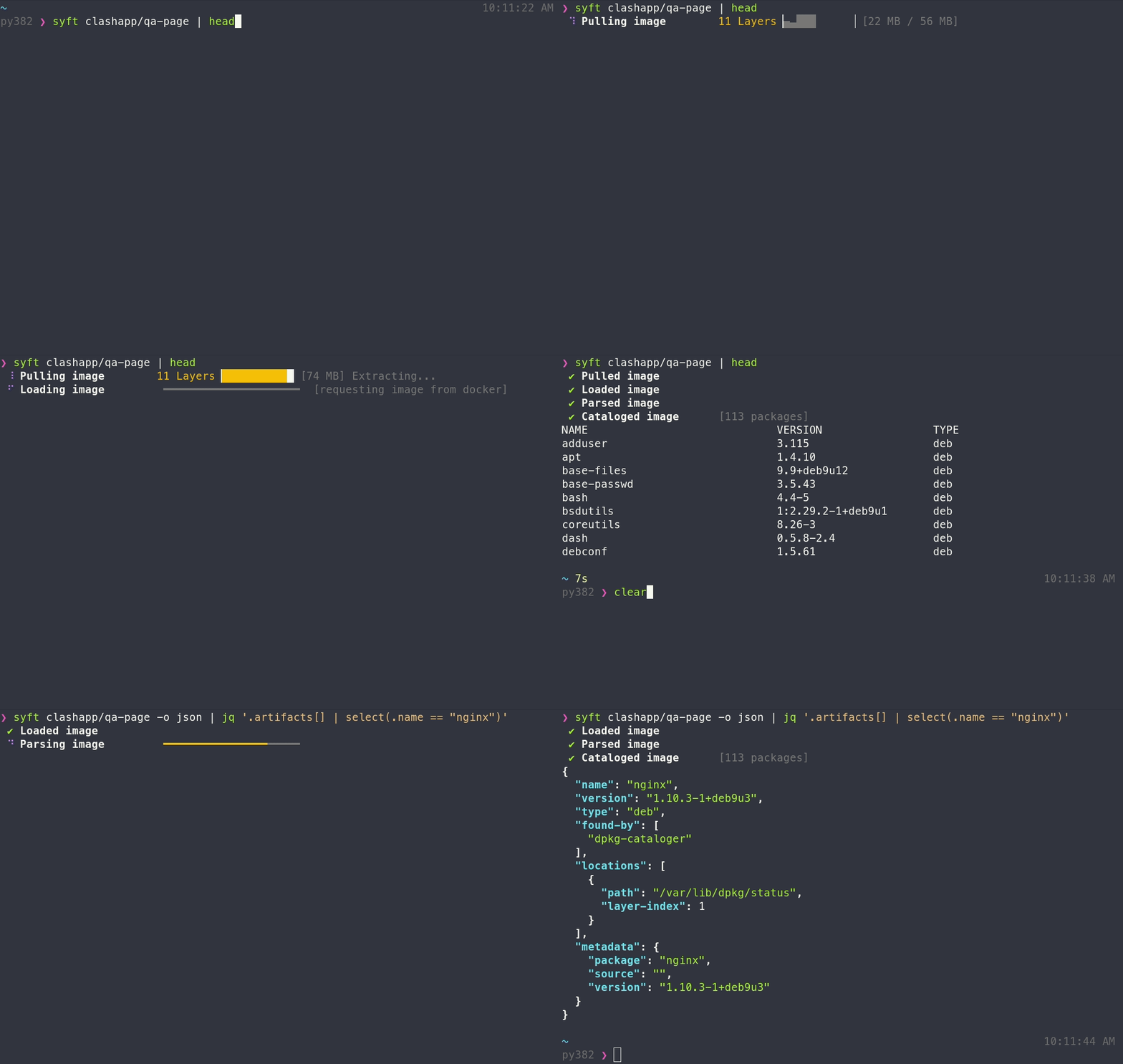
Features
- Generates SBOMs for container images, filesystems, archives (see the docs for a full list of supported scan targets)
- Supports dozens of packaging ecosystems (e.g. Alpine (apk), Debian (dpkg), RPM, Go, Python, Java, JavaScript, Ruby, Rust, PHP, .NET, and many more)
- Supports OCI, Docker, Singularity, and more image formats
- Works seamlessly with Grype for vulnerability scanning
- Multiple output formats (CycloneDX, SPDX, Syft JSON, and more) including the ability to convert between SBOM formats
- Create signed SBOM attestations using the in-toto specification
Tip
New to Syft? Check out the Getting Started guide for a walkthrough!
Installation
The quickest way to get up and going:
curl -sSfL https://get.anchore.io/syft | sudo sh -s -- -b /usr/local/bin
Tip
See Installation docs for more ways to get Syft, including Homebrew, Docker, Scoop, Chocolatey, Nix, and more!
The basics
See the packages within a container image or directory:
# container image
syft alpine:latest

# directory
syft ./my-project
To get an SBOM, specify one or more output formats:
# SBOM to stdout
syft <image> -o cyclonedx-json

# Multiple SBOMs to files
syft <image> -o spdx-json=./spdx.json -o cyclonedx-json=./cdx.json
Tip
Check out the Getting Started guide to explore all of the capabilities and features.
Want to know all of the ins-and-outs of Syft? Check out the CLI docs, configuration docs, and JSON schema.
Contributing
We encourage users to help make these tools better by submitting issues when you find a bug or want a new feature. Check out our contributing overview and developer-specific documentation if you are interested in providing code contributions.
Syft development is sponsored by Anchore, and is released under the Apache-2.0 License.
The Syft logo by Anchore is licensed under CC BY 4.0


For commercial support options with Syft or Grype, please contact Anchore.
Come talk to us!
The Syft Team holds regular community meetings online. All are welcome to join to bring topics for discussion.
- Check the calendar for the next meeting date.
- Add items to the agenda (join this group for write access to the agenda)
- See you there!