 ffb691b0fe
A UPX block's `sz_unc` was passed straight to `make([]byte, n)`, so four bytes of
attacker input spanned the full uint32 range. A ~300KB file could drive multi-GB
resident memory, which Go reports as a fatal runtime OOM that no `recover` on this
path can contain. Syft parses binaries out of arbitrary images, so that is reachable
from any scan.

Two bounds do the work, and UPX's own invariants make them exact:

- all blocks together reconstruct `p_filesize`, so a running remainder caps the sum.
  Bounding only per-block would leave the total at (block count x original size), so
  the remainder is the part that actually closes it
- `p_filesize` sizes the output buffer, so it is capped both absolutely and against
  the size of the file on disk. The absolute cap alone left a ~60 byte header able to
  claim 500MB; the ratio alone cannot work either, since LZMA encodes a run of N
  equal bytes in O(log N) and a `go:embed` of 120MB of zeros legitimately packs 209x

The output buffer is also allocated on the first block that survives validation
rather than up front, so a header claiming a large size with nothing decodable behind
it costs nothing.

Alongside that, several ways the block loop could be steered off its own buffer:

- `parseELFPTLoadOffsets` bounds-checked program headers with `phStart+phentsize >
  len(buf)`, which overflows for a `p_offset` near 2^64 and lets an out-of-range entry
  through into a slice index. Switched to the subtraction form, and a `phentsize`
  shorter than an ELF64 program header is rejected since the reads use fixed offsets
- block placement had the same overflow shape, and on failure it skipped the copy and
  fell through. `outputOffset` derives from the rejected offset, so a `p_offset` at the
  uint64 ceiling wrapped it to 0 and the next block landed on the reconstructed ELF
  header, still returning success. Out-of-range placement now ends the block chain,
  keeping the blocks already placed since those often carry `.go.buildinfo`
- the UPX 2-byte LZMA header carries `lc`/`lp` as nibbles and `pb` as three bits, so
  they can hold values LZMA does not permit. Folded into the props byte they wrap
  (`lc=15, lp=15, pb=7` gives 465, which truncates to 209) and the stream mis-decodes
  instead of failing
- blocks decode directly into a slice of the output buffer instead of a per-block
  buffer that is then copied, so one block no longer doubles peak memory
- the block count is capped: the size budget alone still allows millions of 12-byte
  blocks, each spinning up an LZMA reader

Verified against the `image-small-upx` fixture, a real `upx --best --lzma` binary:
four blocks, max `sz_unc` equal to `p_blocksize` exactly, blocks summing to 0.68 of
`p_filesize`, and a 1.96x expansion against the packed file, so every bound holds with
headroom on genuine output.

Note `p_blocksize` is deliberately not used as a ceiling on `sz_unc`. It adds nothing
the remainder does not already cover, and real output sits at exactly `p_blocksize`,
so it would run with zero headroom against a value the format does not promise.

Signed-off-by: Alex Goodman <wagoodman@users.noreply.github.com>

Syft
A CLI tool and Go library for generating a Software Bill of Materials (SBOM) from container images and filesystems. Exceptional for vulnerability detection when used with a scanner like Grype.






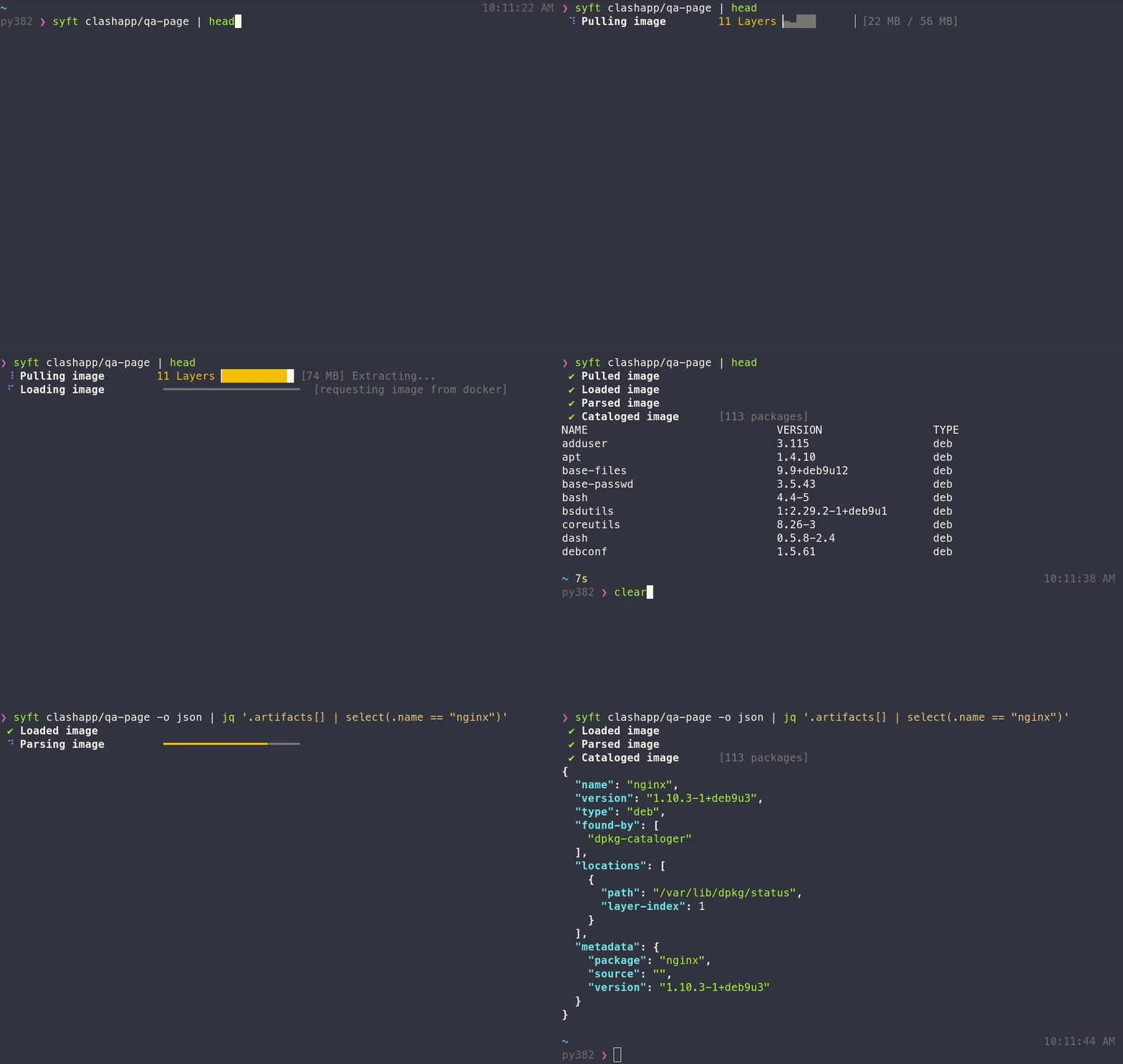
Features
- Generates SBOMs for container images, filesystems, archives (see the docs for a full list of supported scan targets)
- Supports dozens of packaging ecosystems (e.g. Alpine (apk), Debian (dpkg), RPM, Go, Python, Java, JavaScript, Ruby, Rust, PHP, .NET, and many more)
- Supports OCI, Docker, Singularity, and more image formats
- Works seamlessly with Grype for vulnerability scanning
- Multiple output formats (CycloneDX, SPDX, Syft JSON, and more) including the ability to convert between SBOM formats
- Create signed SBOM attestations using the in-toto specification
Tip
New to Syft? Check out the Getting Started guide for a walkthrough!
Installation
The quickest way to get up and going:
curl -sSfL https://get.anchore.io/syft | sudo sh -s -- -b /usr/local/bin
Tip
See Installation docs for more ways to get Syft, including Homebrew, Docker, Scoop, Chocolatey, Nix, and more!
The basics
See the packages within a container image or directory:
# container image
syft alpine:latest

# directory
syft ./my-project
To get an SBOM, specify one or more output formats:
# SBOM to stdout
syft <image> -o cyclonedx-json

# Multiple SBOMs to files
syft <image> -o spdx-json=./spdx.json -o cyclonedx-json=./cdx.json
Tip
Check out the Getting Started guide to explore all of the capabilities and features.
Want to know all of the ins-and-outs of Syft? Check out the CLI docs, configuration docs, and JSON schema.
Contributing
We encourage users to help make these tools better by submitting issues when you find a bug or want a new feature. Check out our contributing overview and developer-specific documentation if you are interested in providing code contributions.
Syft development is sponsored by Anchore, and is released under the Apache-2.0 License.
The Syft logo by Anchore is licensed under CC BY 4.0


For commercial support options with Syft or Grype, please contact Anchore.
Come talk to us!
The Syft Team holds regular community meetings online. All are welcome to join to bring topics for discussion.
- Check the calendar for the next meeting date.
- Add items to the agenda (join this group for write access to the agenda)
- See you there!