 0cebb58eff
Resource sizes and RVAs are user-controlled uint32s that sized buffers before anything
checked the file held that many bytes, so a small crafted section could reserve up to 4GB.

The walk now carries the section's reader and its base RVA for its whole lifetime, so
`reader.Size()` is the single authoritative bound and one `offsetOf` helper rejects every
RVA the section does not hold. That replaces the per-node section value the recursion used
to synthesize, whose size argument was only correct by convention.

Bounding the allocations alone turns the OOM into a hang, though: nothing in the format
stops entries from aliasing, so thousands of them may name one fat blob and every offset
still checks out. A 256KB section built that way drove 24GB of allocation over two minutes
with peak memory flat. Capping entry *count* does not help since the cost is per byte read,
so the walk now charges every read against a budget of a few times the section size. Real
binaries come in at about 1x, since a well-formed section's entries partition it.

A resource tree that stops early no longer fails the whole file. It says nothing about the
CLR directory or an embedded deps.json, and dropping the package from the SBOM over one
malformed section is worse than reporting the fields we did get.

Also widens the entry counts before summing them (two uint16s can sum past 0xFFFF and wrap),
and bounds the name length and section header count against the reader for the same reason.

Signed-off-by: Alex Goodman <wagoodman@users.noreply.github.com>

Syft
A CLI tool and Go library for generating a Software Bill of Materials (SBOM) from container images and filesystems. Exceptional for vulnerability detection when used with a scanner like Grype.






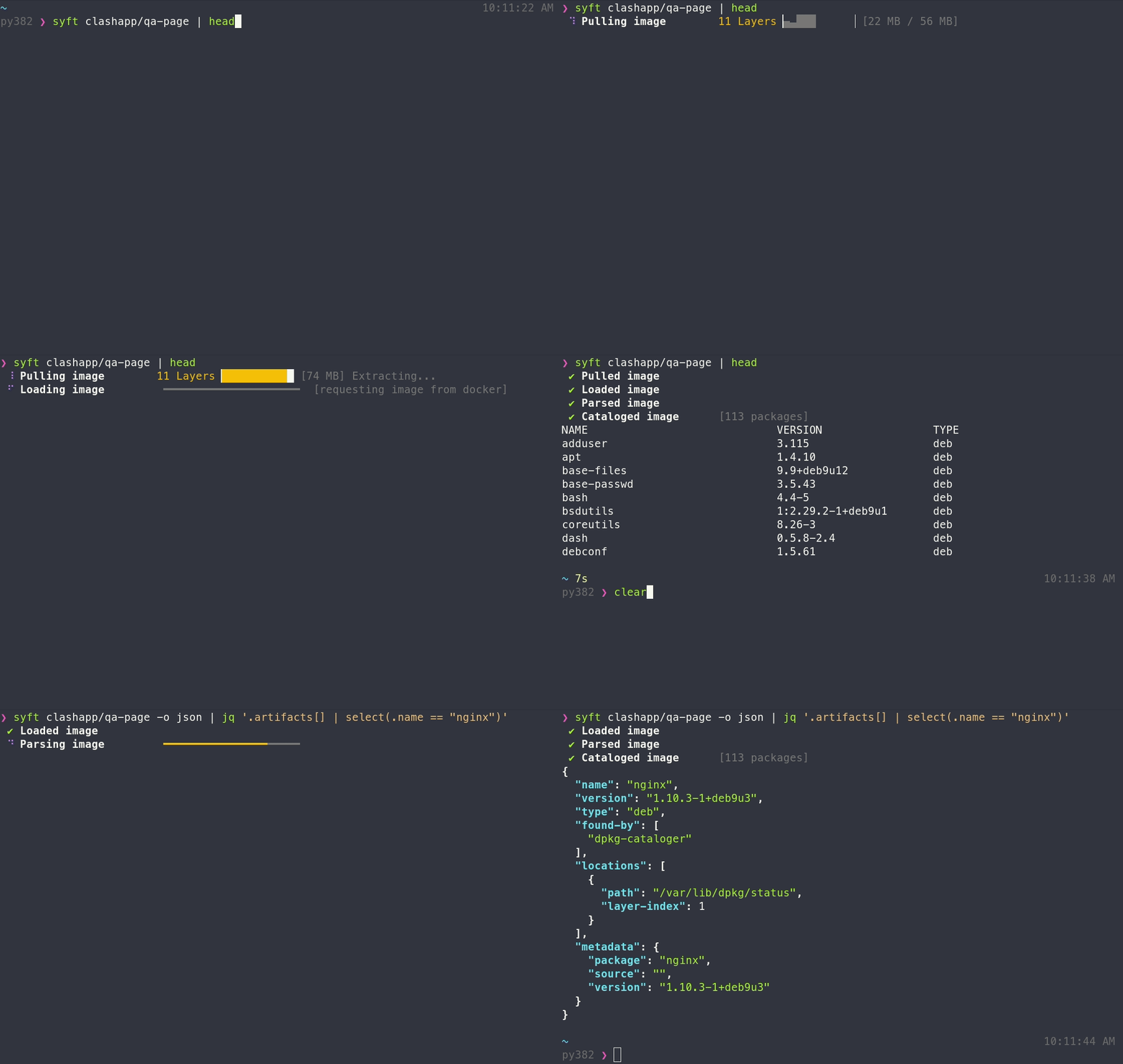
Features
- Generates SBOMs for container images, filesystems, archives (see the docs for a full list of supported scan targets)
- Supports dozens of packaging ecosystems (e.g. Alpine (apk), Debian (dpkg), RPM, Go, Python, Java, JavaScript, Ruby, Rust, PHP, .NET, and many more)
- Supports OCI, Docker, Singularity, and more image formats
- Works seamlessly with Grype for vulnerability scanning
- Multiple output formats (CycloneDX, SPDX, Syft JSON, and more) including the ability to convert between SBOM formats
- Create signed SBOM attestations using the in-toto specification
Tip
New to Syft? Check out the Getting Started guide for a walkthrough!
Installation
The quickest way to get up and going:
curl -sSfL https://get.anchore.io/syft | sudo sh -s -- -b /usr/local/bin
Tip
See Installation docs for more ways to get Syft, including Homebrew, Docker, Scoop, Chocolatey, Nix, and more!
The basics
See the packages within a container image or directory:
# container image
syft alpine:latest

# directory
syft ./my-project
To get an SBOM, specify one or more output formats:
# SBOM to stdout
syft <image> -o cyclonedx-json

# Multiple SBOMs to files
syft <image> -o spdx-json=./spdx.json -o cyclonedx-json=./cdx.json
Tip
Check out the Getting Started guide to explore all of the capabilities and features.
Want to know all of the ins-and-outs of Syft? Check out the CLI docs, configuration docs, and JSON schema.
Contributing
We encourage users to help make these tools better by submitting issues when you find a bug or want a new feature. Check out our contributing overview and developer-specific documentation if you are interested in providing code contributions.
Syft development is sponsored by Anchore, and is released under the Apache-2.0 License.
The Syft logo by Anchore is licensed under CC BY 4.0


For commercial support options with Syft or Grype, please contact Anchore.
Come talk to us!
The Syft Team holds regular community meetings online. All are welcome to join to bring topics for discussion.
- Check the calendar for the next meeting date.
- Add items to the agenda (join this group for write access to the agenda)
- See you there!